
Visit one
Pain
Calm the guarding down.
Gentle hands-on work and easy range of motion settle the irritated tissue, at whatever level your neck will accept right now.
What We Treat
You walked away from it. Two days later your neck won’t turn and your head hurts. That’s the usual order of events, not you making something out of nothing.
That’s the hard part done. We’ll call during business hours to lock in your time.
Prefer to call? (385) 515-4810Sound Familiar?
Two or more? Get it evaluated, even if the crash felt minor.
Why It Happens
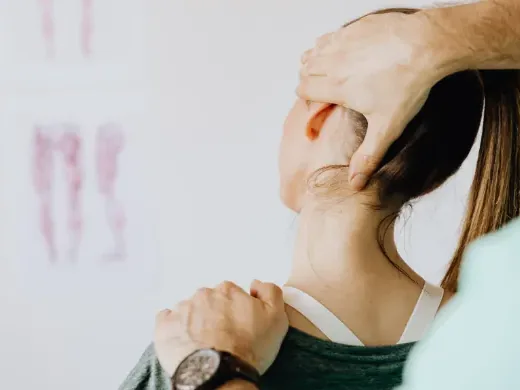
In a collision the car stops and your head does not, not right away. It gets whipped forward and back faster than your neck muscles can brace for. That’s whiplash: small strains in muscles, ligaments and joint capsules that were built for much slower forces.
Adrenaline hides it. For a day or two you feel lucky. Then the chemistry settles, inflammation peaks, and the muscles that got overstretched clamp down to protect the joints underneath. Which is why so many people feel worse on day three than they did at the scene.
You’re the one who told everybody you were fine, because that’s what you do, and because at the time it was true. None of that means you exaggerated it later. It means somebody needs to test the neck properly, segment by segment, and find out which parts took the load.
The Honest Truth
Nobody regrets starting too early.
How We Fix It
Every plan has an endpoint. Here’s what the four phases look like after a collision.
Visit one
Pain
Gentle hands-on work and easy range of motion settle the irritated tissue, at whatever level your neck will accept right now.
First weeks
Prime
We restore motion segment by segment, including the joints that shut down to protect themselves at impact.
Next weeks
Perform
Deep neck and upper back strengthening, so your neck stops relying on a permanent clench to feel safe.
Ongoing
Prevent
Driving position, desk setup and a plan for the flare-ups, all tested before you finish. That’s the endpoint, not another appointment.
The therapists at rock run pt are awesome. They made sure I wasn’t just back to normal, they helped strengthen my ankle so I can enjoy more activities than before my accident.…
Colleen H. · Google review, Roy
Questions, Answered
Very. Adrenaline and inflammation run on different clocks. Plenty of people feel close to fine at the scene, then wake up on day two or three unable to turn their head. Delayed onset is the usual pattern with whiplash, not a sign that you imagined it or made too much of it. Get it evaluated when it shows up, even if the crash looked minor at the time.
Utah is a direct-access state, so no referral is needed to be seen here. Imaging is a separate question. Scans are good at ruling out a fracture and poor at showing the strained soft tissue behind most pain after a crash. If your evaluation turns up anything that needs an image or a physician, we will tell you plainly and help you get there.
Gentle motion at the right dose usually settles a neck faster than a collar and stillness do. A neck that stays still gets stiff, and stiff necks stay sore. Your therapist finds what yours will accept today, then adds to it from there. Being sore afterward is common. A setback that lasts for days is information, and we change the plan around it.
A mild strain and a badly wrung neck are different problems, so we will not guess before examining you. What you get on day one is a plan with an endpoint: the four phases, Pain, Prime, Perform and Prevent, and what has to be true before you move up. Our staff will verify and explain your benefits before you meet with your physical therapist, so the money side is clear too.
Book Your Visit
Request a time and our team will call you to confirm it. No phone tree. Just a plan.
4.9 · 400+ Google reviews
Step 1 of 5
That’s the hard part done. We’ll call during business hours to lock in your time.
Visit Us